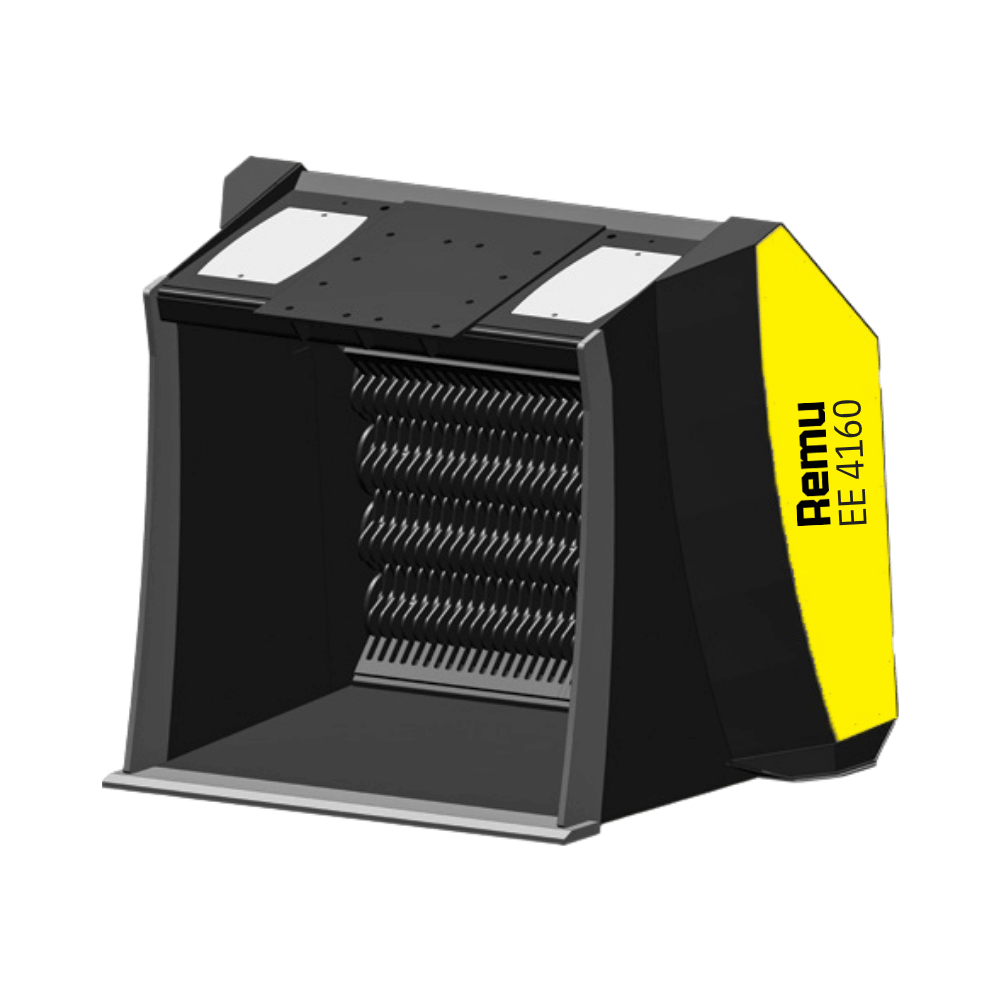
REMU EE 4160

The REMU EE4160 is a high-performance screening bucket designed for 30-tonne excavators, offering exceptional capacity and durability for demanding material processing tasks. Ideal for screening topsoil, compost, peat, sand, bio-waste, and light construction and demolition debris, the EE4160 is suited for large-scale earthmoving, recycling, and remediation projects. The bucket’s continuous hydraulic operation ensures efficient, clog-free performance, reducing the need for secondary screening equipment. Built with a reinforced frame and wear-resistant components, the EE4160 delivers long-term reliability in tough job site conditions. It is particularly well-suited for use in landfill management, large construction sites, and agricultural operations where high throughput and consistent material quality are critical. By processing material directly on-site, the REMU EE4160 minimises transportation and disposal costs while increasing operational efficiency, making it a cost-effective and environmentally conscious solution for heavy-duty screening applications.
Carrier Size:
30 -35 tonnes
Weight:
2780kg
Width:
2000mm
Bucket volume:
2.7m3

Industry-Leading Warranty

1 year/1,000-hour warranty

Benefit from our confidence in product quality with a 1 year/1,000-hour warranty on all Remu buckets.

Features & Benefits

Efficient Material Separation
Solid Gray Screen

The shaft screen system is engineered to separate materials by size. Unlike traditional screening, the shaft mechanism ensures a consistent flow and minimises blockages, even in demanding environments such as mixed demolition waste, compost, or topsoil. The screening bucket could produce different final particle sizes with different rotor blade spacing. This reduces the need for additional processing.

Solid Gray Screen

The screening bucket is designed to be fully operated by a single machine, such as an excavator, wheel loader, or telehandler, without requiring additional personnel. This not only simplifies site operations but also lowers labour costs. The operator has complete control over screening, movement, and placement, ensuring a streamlined workflow from excavation to processing without unnecessary coordination challenges.

Solid Gray Screen

With the attachment powered directly by the machine’s hydraulics, there is no need for separate power units or supporting equipment. By running just one excavator or loader with the bucket, operators save significantly on fuel consumption. This lean approach reduces operational costs and lowers the project’s overall carbon footprint, aligning with both economic and environmental goals.

Solid Gray Screen

Unlike conventional mesh screens that quickly clog in damp or sticky environments, the shaft screen design prevents material build-up. Wet soil, clay content aggregates, compost, and other challenging materials are effectively screened without interruptions. This feature ensures consistent performance in all weather conditions, minimising downtime and eliminating the need for constant manual cleaning.

The excavator’s ability to move while screening enables the direct placement of processed material into stockpiles or trucks. This feature is especially valuable on sites with restricted working space, as it eliminates the need for additional conveyors or re-handling equipment. Now the screening could be performed anywhere.

Crushing Buckets Frequently Asked Questions

Where to use the crushing bucket?

Save time and money by processing demolition waste onsite. In an ideal case crushed material can be reused onsite, but even if the material needs to be transported to a recycling facility, crushing reduces the volume and helps to save transportation costs. A crushing bucket is also an affordable investment to recycling centres to process their material piles and turn those into valuable products.

Compared to a crushing plant, the bucket crusher is a more affordable investment and can solve a number of material handling needs. Also, the operating cost is only a fraction of that of bigger plants. You only need one excavator, one bucket and one operator.

The rotary crusher bucket offers a steady throughput, and with a number of materials a capacity of 60m3/hour can be achieved.

Excessive fine material does not interfere with the crushing process in this rotary crushing bucket. This type of crushing technique is particularly suitable for processing mixed materials.

Wear parts for the CR 1100 consist mainly of carbide crushing picks which are quick and easy to change. Compared to the wear parts of some other type of crusher buckets the picks are much more affordable and convenient to store, transport or take to site.

If a material is too hard to process, the rotor simply stops, after which the rotor can be reversed and the unbreakable material dumped out of the bucket.

According to our experience most of the wire/cables go through the bucket.

There are different types of natural stone, and some are easy to crush while others are not. Sandstone, shale, claystone, and soapstone are processable. The hardest natural stones, like granite, cannot be processed with our bucket.

Stay up to date with our latest insights